Angus Rowboats banner_wordpress_blog.jpg

Back in Action

December 29th, 2011 by admin
Respond

Well, we’ve completed our four-month National Geographic Expedition voyaging through the Mediterranean exploring the origins of the olive and how this humble fruit shaped our modern world. Things have been very hectic since arriving home due to a family emergency combined with Julie undergoing surgery, however, we’re getting back on track again.

The store is scheduled to open in the New Year, and we will be selling plans for the Expedition and Cambridge Racer. Plans for the Cruiser Rowboat and the Salamander will be available later in the spring.

A few people have asked about kits. We have been trying for a long time to have kits available for some of our designs, but have come to the conclusion we are simply stretched too thin to get kits going in the near future. We want to make sure we have the time to produce top quality kits – not something slapped together in a hurry.

The good news, however, is that building from full-sized plans isn’t really that much more difficult than building from a kit, and you have the satisfaction of constructing the vessel entirely yourself. One of the most important things when building from plans is being able to source quality materials for a reasonable price. In the next few months we plan to list a compilation of some of the best sources around the world for marine plywood, epoxy supplies and other essential boat-building materials.

We look forward to seeing you out in some of our vessels, and in the meantime, a Merry Christmas and Happy New year to all.

A section of Mediterranean coastline we passed on our four-month voyage revealing the secrets of the olive.

A section of Mediterranean coastline we passed on our four-month voyage revealing the secrets of the olive.

Tags: No Comments.

Big Adventures and Temporary Store Closure

May 30th, 2011 by admin
Respond

We’ve got three big adventures coming up, and are closing the store temporarily until December so we can focus 100% on the expeditions.

Starting mid June, I’ll be attempting to break the speed record for circumnavigating Vancouver Island’s 1150 km coasline and will be using the Expedition Rowboat. That will be followed by an attempt to break the Guinness World Record for the greatest distance travelled on flat water in 24 hours in a human powered boat. And finally, in August, Julie and I are departing on a National Geographic expedition sailing/rowing the length of the Mediterranean as Julie researches her book “Olive”. You can follow it all at www.angusadventures.com. For those interested in ordering plans or other gear, the store will be back open in December and we’ll have plans for the 16′ wherry and the camper boat shortly after.

We’ll still be able to answer any questions you might have on the forum, although there may be short delays here and there.

Happy boating!

Tags: No Comments.

Rowing Yacht

May 13th, 2011 by admin
Respond

Finally – it’s done. The past many months have been dedicated to designing and building the first coastal cruising rowboat that’s truly practical.

Row hard, drop your anchor, and relax through the night

Row hard, drop your anchor, and relax through the night


It’s not easy by any means. The problem is a human only generates a fraction of a horsepower. If you make a big heavy boat with large cabins and abundant wetted area it will be unwieldy and unseaworthy. The unseaworthiness is attributed to the fact that it is quickly overpowered by sudden strong winds and can be blown into a lee shore. Additionally, rowing progress will be poor in all but calm conditions or tailwinds.

What about ocean rowboats, you may wonder? Don’t people cross oceans in big heavy bulbous vessels? Actually, ocean rowboats make extremely dangerous coastal cruisers. They are only safe when out at sea, far away from any hazards of land. And from a performance perspective, they only do well in calm conditions or with tail winds. This is why every ocean rowing route is chosen to go with prevailing winds and currents. With coastal rowing however, we have to deal with rocks, contrary winds, and restrictive waterways.

To make a rowing boat that could have the comfort of a small cruising sailboat, yet offer the performance of a small sleek sea kayak (in all kinds of weather conditions), we really had to focus on miniaturization. The cabin had to be low, the boat light, and the camping accessories small and stowable.
The goal was to have a boat that could row well, yet be a comfortable home when anchored. It needed to be seaworthy enough to voyage in gale-force conditions, be unsinkable, and still be pretty. After taking the boat on her maiden camping voyage last week, we were pleased that it performed just as we’d hoped.

The boat is 19’ long, 175 lbs fully rigged.
You can check out the pics here: Camper rowboat pics

Currently we’re going full steam ahead with our expedition planning (three projects this summer) so we won’t have plans available until the winter of 2011.
For those inquiring about the wherry , we’ve created the basic hull, but won’t have time to finish it until getting back from our expeditions. Again, it should be ready in the winter of 2011 with plans available shortly after.

Tags: 14 Comments

New Boats Galore

January 6th, 2011 by admin
Respond

It’s been a long dark winter, but we’ve been having fun in the shop building and designing a few different projects. Three things are currently on the go: easy-to-build hollow shaft oars, a lightweight 16’ open wherry, and the pinnacle of human-powered decadence – a cruising rowboat. All should be completed in about two months, and then we’ll have plans available shortly after.

The cruising rowboat is a concept I’ve pondered for years, and when a fellow inquired about the possibility of us building one for an expedition he is planning, I jumped at the chance to design and build it.

Constructing a human powered boat that has comfortable accommodation on board for camping on the water is a delicate balancing act. It’s imperative to remember we only produce ¼ horsepower, meaning we can’t propel heavy cumbersome vessels into adverse weather. An overbuilt boat powered only by oars, in fact, is dangerous and unseaworthy when near land. An ocean rowboat, for example (the type used for crossing oceans), would be the worst type of craft to use for coastal rowing or on a non-downwind down-current route because of its excessive size and windage.

With this in mind, I set out to design a boat that would be lightweight (about 150 lbs), with minimal windage, and powered with a sliding seat rowing system – the most effective way of harnessing human energy on water. The 19’ vessel will have a comfortable sleeping cabin with a pop-top hatch, and the cockpit will double as both the rowing area and the evening lounge. This will be achieved with a small retractable table and countertop (with stove, sink and prep area) which stows when the boat is underway.

This decked boat will be fast and seaworthy and camping at the end of the day will be as easy as finding a sheltered anchorage and dropping the anchor and opening a bottle of wine.

The other boat we’re close to finishing is a sixteen foot open wherry. This boat is a fusion, combining the traditional lines and wineglass transoms of the boats of yore along with modern hydrodynamic theories and lightweight construction. For those looking for a handsome boat and fast full-body workout, this will be the boat for you.

And finally, we’re crafting a pair of hollow-shaft oars from spruce similar to how racing oars were built before the advent of carbon fibre. Amazingly, good hollow wood oars are only slightly heavier than the lightest commercial oars available. It is labour intensive, but we’re working out the easiest and most efficient way to build them.
Within a month or two, we’ll have a slew of photos for all these projects followed shortly after with plans and manuals.

We hope you’re all having a great New Year, and good luck with all your boating plans!

Tags:   · · · · · · · · 5 Comments

Plans for the Cambridge Racer now available

October 15th, 2010 by admin
Respond

Cambridge Racer

Cambridge Racer

We’ve spent the last six weeks rigorously testing the Cambridge Racer, and it’s been performing flawlessly. Most of the testing has been in the open waters of the Georgia Strait. While the weather was generally calm, the Cambridge Racer handled the occasional swell from passing boats with aplomb, and easily moved through the breeze-ruffled waters. The maximum speed I could coax from the boat is 15 km/hr, and I could travel 12.2 km in one hour in open (but calm) water. My rowing technique is far from ideal, and undoubtedly, an expert rower would achieve even better speeds.

Unlike our Expedition boats which are virtually impossible to capsize, the Cambridge Racer is a much more tender vessel. Rowing racing shells is relatively new for me, and at one point I caught an oar and capsized quite far from shore. This was the first test for self-rescue, and I was pleased that it took only a few minutes to re-enter the boat, bail the water, and be underway again. The process would have been even faster if I had something better than a small sponge to bail out the three or four gallons of water in the cockpit.

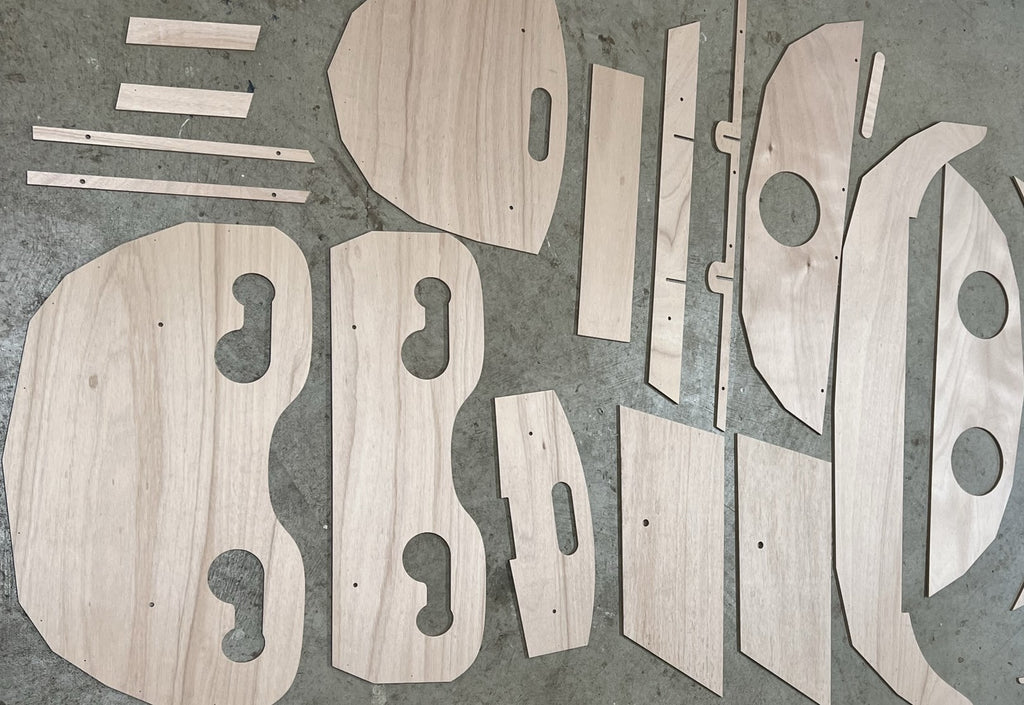
Plans for the Cambridge Racer are now available on our website. We have full-sized plans available, which makes it an easy process creating the hull panel shapes. This is a relatively easy boat to build, and can be completed in about six weekends. Kits will not be available until we finish designing our Salamander model, at which point we will be developing pre-cut wood panel kits for all three boats.

Tags:   · · · · · No Comments.

Maiden Voyage

September 6th, 2010 by admin
Respond

We’ve been sending plans for the Expedition Rowboat to countries around the world including Australia, France, Germany, England and Norway, so we were intrigued to hear that a builder here on Vancouver Island had completed his boat and was ready to launch. We snapped some photos as Simon Gabbott of Parksville launched his shiny new Expedition for its maiden voyage. Well done Simon. Simon painted his hull and varnished the decks for a nice eye-catching combination. The hatches have been slightly customized so suit his needs. You can see more pics of his boat on our online gallery

Simon rowing his new Expedition Boat

Simon rowing his new Expedition Boat

.

Tags: 1 Comment

New Rowboat Launched

July 4th, 2010 by admin
Respond

We’ve designed and built our newest rowboat, the Cambridge Racer. As you may have guessed from its name, this boat follows the lines of traditional rowing sculls, and is designed for speed. The 39 lb (17.5 kg) vessel is constructed from marine Okoume plywood, epoxy and fibreglass. Attributes incorporated to ensure a fast ride include a long waterline length (24’), narrow beam, and minimal wetted area.

Fingers were crossed as we launched the boat at our local marina on Vancouver Island. A few spectators gathered nearby as I climbed into the tender vessel. Fortunately, the rowboat handled exactly as we’d hoped and slipped easily through the water as I pulled on the oars. After a few full strokes the GPS registered 13.3 km/hr (7.2 knots). The stippled bottom hasn’t yet been sanded and painted, and foot straps are still to be added, so we’re hoping the boat will be able to move at 15-16 km/hr when complete.

The ergonomics for the lightweight (13 lb) sliding rowing system felt good. All the dimensions, angles, etc are identical to that developed for competitive racing shells. One thing that needs to be finessed is the adjustable footplate. We’ve created a unique design for adjusting the footplate, but felt there was a little bit too much play from side to side. This will need to be modified.

The boat isn’t quite complete. Over the next couple of weeks we’ll be tweaking the footplate, adding the round hatches, fairing and painting the vessel, and experimenting with the skeg (reducing the skeg size to the minimum required). For those interested in building a rowing scull, we will have full-sized plans and manuals available after completing several weeks of thorough testing. Full kits will be available at a later date (expected to be $800-900).

We’re creating the Cambridge Racer to try breaking the 24-hour flat water human powered distance record. The attempt will take place in the spring/summer of 2011.

Colin rowing Cambridge Racer in Comox marina

Colin rowing Cambridge Racer in Comox marina (click on image to view more pictures of the rowboat)

Tags: 2 Comments

Full-sized hull plans available

April 20th, 2010 by admin
Respond

Full-sized hull plans are now available for the Expedition model. The 19′-long plans make the process of transferring the hull-panel shapes onto plywood a simple and quick process. We recently built a hull from the full-sized panels to check for accuracy and to familiarize ourselves with the process. It took five hours to scribe and cut the panels. For a beginner, or someone working slowly to ensure accuracy, we expect the process would take 7-12 hours.

Tags: 3 Comments

Store is open

February 26th, 2010 by admin
Respond

We’re pleased to finally open our online store. We currently have plans, parts, oars, rowing hardware and other gear to get you out on the water. Unfortunately, the CNC-cut wood components we had hoped to have available now are still on hold. We want to ensure the wood pieces are of the highest quality before passing them on to our customers, and there are still some aspects to work out. We will keep you posted.

In the meantime, we do have plans and and parts kits (excluding wood components) available, so for those of you keen to start building, get ready to rock and roll.

Tags: 5 Comments

Expedition rowing scull kit progress

December 24th, 2009 by admin
Respond

Things are moving along well with the development of the kits and plans, and we anticipate the Expedition Model will be ready for shipping by Feb 1. Our director of production, Malcolm Chaddock, is also working hard on a CNC project for the Winter Olympics – making the rings displayed below the ski jump.

Tags: 6 Comments